$5.99 SHIPPING ANYWHERE (FREE LOCAL)

(A water process decaf coffee is the best way to get a chemical-free cup of coffee. Learn more about the differences between the two types of water process decaf coffee.)
Types of decaffeination processes?
When selecting a decaffeinated coffee, there are a few choices as consumers that you should know about. Decaf coffees can be divided into two categories, chemical processed and water processed decaffeinated.
Chemicals Decafs
Water Processed Decafs: Swiss Water Process and Mountain Water Process
.
Chemical Processed Decaffeination
The most common process for decaffeinating coffee in the United States involves the use of a chemical, Methyl Chloride (CH3Cl), also known as chloromethane. Methyl Chloride (MC) is a gas that is colorless, flammable, and is toxic. If you'd like to look it up, there is an article with more about (MC) here.
Methyl Chloride Decaf
The MC decaffeination process involves soaking the green coffee beans in hot water to extract the caffeine, which also removes the water-soluble components (the flavor). The beans are then removed from the water, and the MC is added to bond with the caffeine. The MC and the caffeine are skimmed off, and the green coffee beans are returned to the water to reabsorb the water-soluble components that were previously extracted. This process is about 94% effective.
By the inherent nature of processing, MC decafs will never be organic. Plus, it has a residual processed flavor, which means the great taste of high-quality coffee would not be used in a method that would taint the coffee bean's brilliance. That is why, traditionally, decaf coffee was always so bad. It has poor-quality coffee beans with a lingering processed taste. The base green coffees usually score low in the 70s (that's bad). Now, enter stage right, the water-based decaf.
Water Processed Decaffeination
Unlike Methyl Chloride decafs, water-based decaffeination processes do not use any chemical solvents. These methods are 100% chemical free, more natural, and completely water-based. Since the Swiss Water process and Mountain Water decaf process are solvent-free processes, both conventional and organic green coffee beans can be used.
Since these water decaffeination process methods do not have a residual taste from chemical solvents, high-quality coffee beans can be used, which scores in the 80's (that's good) and above.
Swiss Water Process Decafs: Background
The most popular of the water based decafs in production today is Swiss Water decaffeinated processed coffee. This is the name that most people think about when considering decafs. The water was developed as a process in Switzerland nearly 100 years ago, dating back to 1933. Commercial introduction wasn't until 1980.
Swiss Water Decaf Process
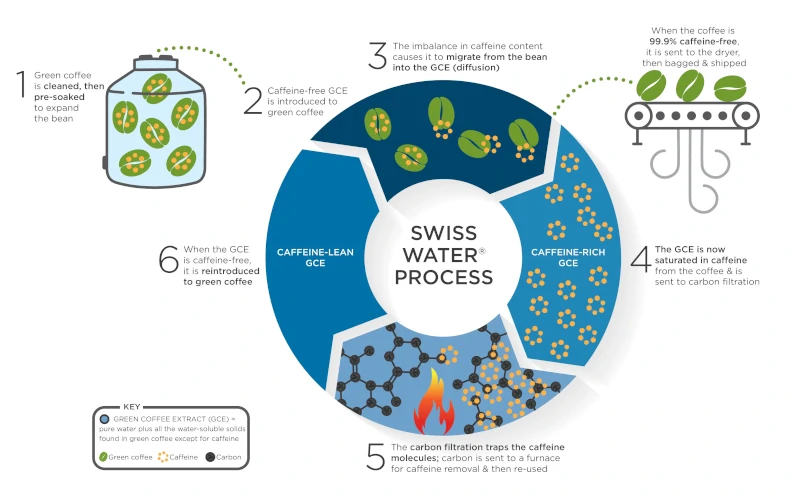
Swiss water is a water processing decaffeination method. In this water process, the green coffee beans are pre-soaked in water to expand the bean, making it more permeable. Then a solution called Green Coffee Extract in introduced to the beans. This solution draws off the caffeine and other water-soluble components (flavor components).
The Green Coffee Extract (CGA) solution then goes through a carbon filter, separating away the caffeine molecules, and the CGA is reintroduced back to the coffee. This helps the beans maintain their original flavor. The beans are then dried to 8-11% and are ready for use. Drying is important for any coffee; if the beans are too dry, they age quickly, lose flavor, and certainly will not roast correctly. Too wet, and the beans mold.
While not completely caffeine-free, Swiss process coffees achieve about 99% caffeine extracted. Leaving residual caffeine at less then 1%.
Mountain Water Decafs: Background
While not as popular as the Swiss process method, the Mountain Water process became available in 1981. A Mountain water decaf method also uses a 100% water based decaffeination process. Located in Vera Cruz, Mexico, Descemex produces among the best processed decafs in the world. Uses "pure water" from Pico de Orizaba, Mexico. Pico de Orizaba is reportedly the highest mountain in Mexico.
Mountain Water Decaf Process
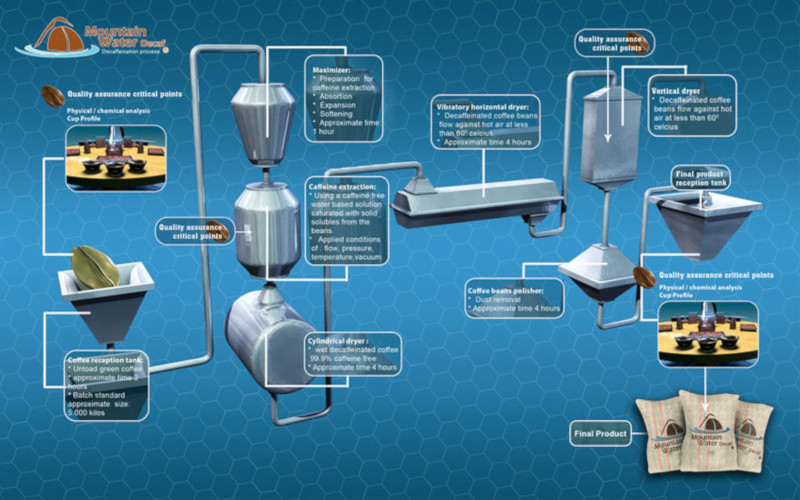
To remove the caffeine from the green coffee beans, coffee beans are received for processing, sampled, and lab tested. A water-soluble solution is developed based on the analytical profile of the coffee beans. The coffee beans are prepared for processing. Preparation involves a process of the coffee beans being soaked in water to start absorption. The immersed coffee beans expand, and softening of the coffee bean shell and cellulose structure occurs, making the coffee membrane more permeable in order to allow for caffeine molecules and the water-soluble compounds (flavor components) to be removed.
The caffeine is separated from the water-soluble solution and delivered back to the coffee beans via a stream immersion. This way the beans maintain their original flavor, and it is not lost to the extraction process. When the processing is complete, the beans go through a series of cylindrical, vibratory, and vertical dryers to bring the dried coffee to a stable moisture content. Optimal moisture content for green coffee beans is between 8-11%. The coffee beans leave the plant with 99.94% of the caffeine extracted. While not completely caffeine-free, residual caffeine comes in around 0.06%. That is effective as it gets.
Swiss Water Decaf vs. Mountain Water Decaf
You can see Swiss Water process and the Mountain Water process each have a unique water-based method for removing the caffeine without the chemicals and doing so while still retaining the original flavor components of the green coffee beans. This is because it minimizes and, in some cases, eliminates any residual process flavors on the beans. It's chemical-free.
Both processes virtually eliminate caffeine from the coffee bean. Although the Mountain Water process appears to be slightly better. Let's keep in mind we are only talking about a difference in near trace amounts.
The Swiss Water Process coffee is quite good. However, with the Mountain Water process, you can't tell the difference between the decaf and regular coffee.
Swiss Water or Mountain Water: The Winner
Both are very good, while some prefer Mountain Water decaf, we can't really say anything bad about the Swiss Water. However, if you transition away from any of these chemically processed Methyl Chloride decafs to either a Swiss Water decaf or a Mountain Water decaf, you'll be able to taste the difference, and you'll be the winner.